


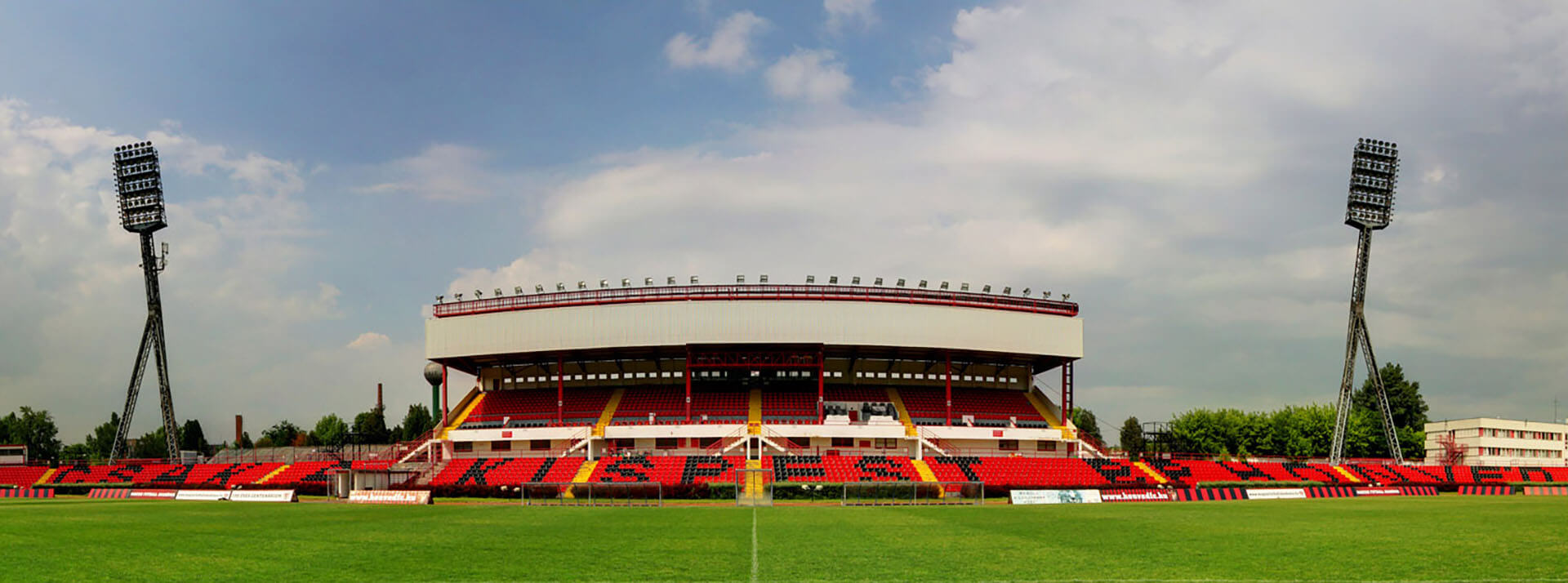
The History of Bozsik Stadium
HISTORY:
Not far from today's stadium—where the cemetery is located today—the team's first home pitch was constructed. The municipality donated a plot of land at the end of Sárkány utca to KAC, and the club launched a fundraising campaign among Kispest tradesmen and merchants. The sports ground was built primarily thanks to the substantial financial support of hotel owner Ferenc Polacsek and timber merchant Ferenc Herbacsek. The facility on Sárkány utca was inaugurated in 1913, which opponents later appropriately nicknamed the "Dragon's Den". On November 18, 1926, the town of Kispest voted in favor of granting 500 million crowns to modernize the Sárkány utca pitch. In 1935, during a match against Attila, the wooden grandstand and the club buildings burned down; fortunately, no lives were lost. Thanks to club president József Molnár, this disaster did not cause a crisis at the club, and that very same year a new, substantially larger, and more modern grandstand was erected.
On Sunday, January 2, 1938, Kispesti AC's new sports facility was inaugurated. The new arena was located next to the terminus of tram line 42, with a capacity of 8,000 spectators (5,000 seats and 3,000 standing places). By that time, it also featured hot and cold running water in the washrooms, which was considered extraordinary in those days. On February 12, 1939, a new chapter opened in the life of Kispest with the Kispest–Nemzeti league match: a modern pitch was unveiled, with grandstands capable of hosting 15,000 spectators. By then, the playing surface was covered with natural grass turf.
In 1945, almost immediately after the end of the war, the people of Kispest began reconstruction work. They laid new turf, repaired the covered grandstand built of concrete, and built a training pitch in the area extending to the cemetery.
In 1955, the pitch was reconstructed and expanded, forcing the team to play the entire league campaign away from home. On May 20, 1967, floodlighting was inaugurated during a friendly match against Szombathelyi Haladás. At that time, the stadium had a capacity of 25,000 spectators. The team also had one grass, one cinder, and one dirt training pitch at its disposal.
Kispest was the first place in Hungary where a stadium was named after a football player, and who else could have been more deserving than the 101-time Hungarian international star, József Bozsik. On the first day of October 1986, the Bozsik Stadium was inaugurated in the framework of a colorful, spectacular ceremony, highlighted by the Bp. Honvéd–Bröndby European Champion Clubs' Cup clash. Before kickoff, Lajos Tichy spoke on behalf of the Kispest footballers, followed by a speech from Sándor Kiss, then-president of the Red-and-Whites. A fireworks display concluded the vibrant gala. Regrettably, what followed on the pitch did not turn out as the 15,000 visiting fans had hoped: Honvéd managed only a 2–2 draw with their rival, and having lost in Denmark, bid farewell to the premier European club competition.
For the renaming, the stadium received new, more powerful floodlights, the pitch was completely returfed, and the playing area became wider and longer. A 20-room hotel was also built within the stadium grounds, complete with a 200-seat restaurant on the ground floor. Following this, major works were carried out at the stadium in 1990, during which the dressing rooms and shower facilities were refurbished, and the old gymnasium was converted into a VIP club.
The next milestone in the history of Bozsik Stadium came in the summer of 2006, when the Hemingway Group arrived in Kispest. Following the decision of George F. Hemingway, the new owner of Budapest Honvéd, the historic sports ground was renovated before the start of the spring 2007 season—financed through private funds, which was a rarity in Hungary. In September 2006, reconstruction began with the main pitch and the grass training pitch (the former received a drainage and automatic sprinkler system, followed by fresh turf; the latter was revitalized using established turf techniques). A new perimeter fence was erected around the stadium; 6,000 plastic seats, naturally in red and black, were installed in the renewed stands; the press box was modernized, a state-of-the-art gym was built, and the sound system, pitch lighting, and safety measures were enhanced with a new CCTV system. The service areas were overhauled—the buffets, club shop, laundry, changing rooms, showers, and restrooms were all refurbished. The renovation of the Bozsik Stadium was carried out by Encsi Bau Kft. and Háder Lakatosipari Vállalkozás to everyone's greatest satisfaction. The precision and flexibility of the latter was demonstrated by the record speed at which they fabricated new camera positions to support television broadcasting.
The renovation of the building hosting the students of the Hungarian Football Academy began in March 2006 and was completed in July 2007. In the autumn of 2007, club management took a momentous step: Bozsik Stadium became the first stadium to dismantle the perimeter fences around the stands following the fence-building wave of the 1990s. This was unique in Hungary. In December 2008, the artificial turf pitch with a 200-seat stand was inaugurated.
Referring to this venue in the past tense is justified because on September 22, 2018, the Club and the supporters bid farewell to Bozsik Stadium at a family day featuring a gala match, paving the way for a brand-new, modern UEFA Category 4 stadium to be built in its place.
Capacity of the former Bozsik Stadium: 10,000 (6,000 seated, 4,000 standing)
Pitch dimensions: 105 x 68 m
During construction, 100 percent of the concrete and brick rubble from the old stadium was recycled into the new facility. In April 2019, an unexploded 250 kg World War II bomb was discovered in the area of the old rear grass (formerly dirt) pitch, which was defused on site by bomb disposal experts on April 28. On August 26, 2019, during a complete track closure of the adjacent railway, a 20-meter-long, 16-ton bridge element was hoisted into place, allowing away fans to access the stadium. The construction reached its highest point on December 6, 2019, marked by the traditional topping-out ceremony attended by the Kispest supporters, whose chants filled the new stadium for the very first time.
The opening ceremony took place on July 24, 2021, when our team inaugurated the new facility, now named Bozsik Aréna, in a friendly against the B team of Europa League winners Villarreal. Prior to kickoff, club legends greeted fans at the Lipták Grund area, and the new outfit of our mascot lion, Leo (III), was unveiled. Thanks to the Hungarian Defence Forces, a military parachutist delivered the match ball, and the Bagossy Brothers Company performed before the match and at half-time. For the ceremonial ribbon cutting, our club's oldest living champion at the time, Antal Bárfy, the namesake's son Péter Bozsik, and co-owner Dániel Mendelényi cut the national tricolor ribbon, while the ceremonial kickoff was taken by Ane de Juan, great-granddaughter of Ferenc Puskás. Djordje Kamber featured in the starting eleven of the 0–0 draw, bidding farewell to his professional playing career after making 243 appearances in red and black.
In front of the stadium, the supporters' pub opened under the name Lipták Grund Pub, beside which a six-meter-tall lion sculpture weighing 6 tons and made of nearly 6,000 elements (created by Gábor Miklós Szőke) welcomes visitors and "guards" the arena. What is more, the lion statue stands roughly where the former Lipták Grund and the homes of the Puskás and Bozsik families once stood, where our club's two greatest legends grew up.
Bozsik Aréna in numbers
8,200 spectators
105 x 68 meter pitch
70,000 m2 plot
8,200 m2 built-in area
23,300 m2 green space
30,500 m2 paved area
1,500 powder-coated red, black, and white cladding elements
1,150 precast reinforced concrete elements
750 tonnes of steel structure
8,000 m3 of concrete
1,100 tonnes of reinforcing steel
228,400 meters of high- and low-voltage cabling
18 turnstiles
438 parking spaces
242 LED pitch lights
320 m2 of solar panels
2 Giant Screens of 50 m2 each
250 running meters of LED perimeter advertising


